
Inside Sichuan's Soviet Assembly: 28 Active-Duty PLA Officers and Beijing's Handpicked Delegates

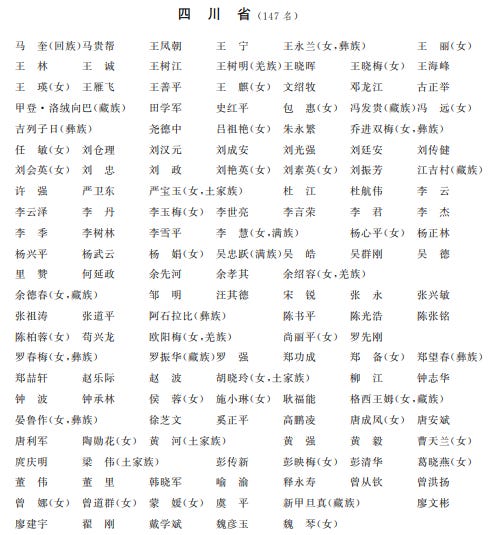
On January 15, 2023, the Third Plenary Meeting of the First Session of the 14th Sichuan Provincial Soviet Assembly elected 147 deputies to the 14th National Soviet Assembly (NPC). This total matches the number later published in Bulletin No. 2 (2023) of the NPC Standing Committee.
Among those elected were several candidates nominated by the CCP Central Committee, including:
Zhao Leji
Li Ji
Song Rui
Tian Xuejun
Du Hangwei
Du Jiang
Xi Zhengping
Zhong Zhihua
Liu Zhenfang
Zhang Xingmin
Zheng Gongcheng
The PLA Bloc in the 14th Sichuan Provincial Soviet Assembly
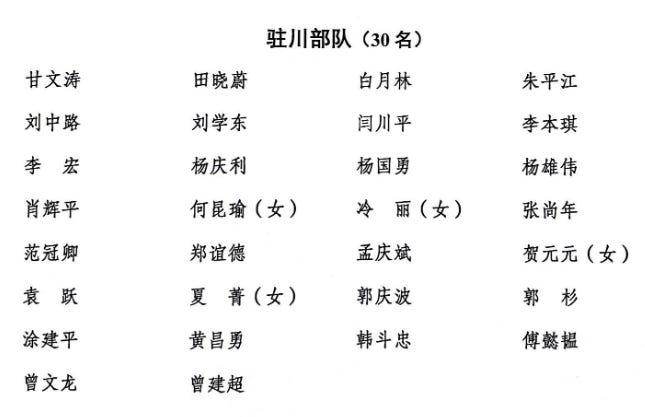
One week earlier, on January 8, 2023, the Standing Committee of the 13th Sichuan Provincial Soviet Assembly announced the membership of the 14th Sichuan Provincial Soviet Assembly. The official roster included 30 active-duty Communist Army (PLA) officers.
The continued presence of a sizable military delegation illustrates how the PLA, under the command of the CCP Central Military Commission (CMC), maintains institutional representation within provincial legislatures that are responsible for electing deputies to China’s highest legislative body.
The 13th National Soviet Assembly Election (2018)
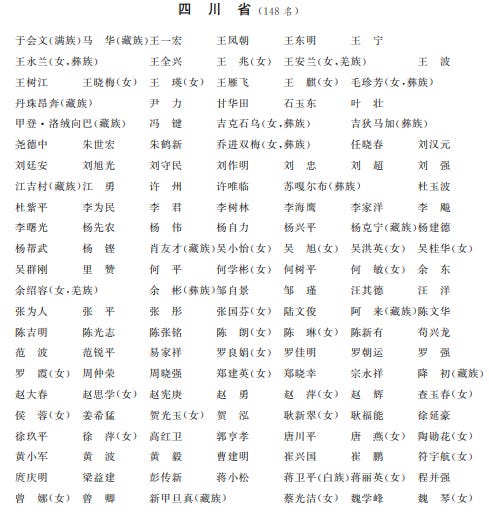
On January 30, 2018, the First Session of the 13th Sichuan Provincial Soviet Assembly elected 148 deputies to the 13th National Soviet Assembly, matching the total published in Bulletin No. 2 (2018) of the NPC Standing Committee.
The delegation included numerous candidates nominated by the CCP Central Committee, including:
Wang Yang
Cao Jianming
Du Yupo
Danzeng Angben (Tibetan)
Li Jiayang
Zhao Xiangeng
Jidi Majia (Yi)
Xu Yanhao
Gao Hongwei
Zhang Ping
He Hong
Twenty-Eight Active-Duty PLA Officers in the 13th Sichuan Provincial Soviet Assembly
On January 23, 2018, the Standing Committee of the 12th Sichuan Provincial Soviet Assembly published the membership of the incoming 13th Sichuan Provincial Soviet Assembly. The official list included 28 active-duty PLA officers serving under the command and leadership of the CCP Central Military Commission.
The officers included:
Xian Weiping — Director, Directly Subordinate Affairs Bureau, Joint Staff Department, PLA Western Theater Command
Li Yang — Director of the Political Department, Sichuan Provincial Military District
Li Yong — Commander, Ganzi Military Subdistrict, Sichuan Provincial Military District
Li Bo — Director, General Office, Political Work Department, PLA Western Theater Command
Li Yuanxiang — Commander, Chengdu Garrison, Sichuan Provincial Military District
Li Jialin — Deputy Director, Political Work Bureau, Chengdu Military Region Transition Office
Wu Dilun — Political Commissar, Ziyang Military Subdistrict
He Qiwei — Deputy Chief of Staff, PLA 77th Group Army
Leng Zhiyi — Political Commissar, Sichuan Provincial Military District
Wang Zeyuan — Political Commissar, Mianyang Military Subdistrict
Zhang Li — Director, Political Work Department, Sichuan Provincial Military District
Luo Jun — Political Commissar, Guangyuan Military Subdistrict
Zheng Jiansen — Deputy Commander, Neijiang Military Subdistrict
Jiang Yongshen — Commander, Sichuan Provincial Military District
Xu Chengxiang — Commander, Meishan Military Subdistrict
Qin Guanglong — Political Commissar, Panzhihua Military Subdistrict
Xia Lizuo — Commander, Yibin Military Subdistrict
Huang Yong — Deputy Political Commissar, PLA Unit 63820 (Military Space Forces)
Huang Zhihui — Political Commissar, Dazhou Military Subdistrict
Dong Zhiyong — Commander, Luzhou Military Subdistrict
Jiang Jinan — Commander, Nanchong Military Subdistrict
Pu Lunfu — Deputy Commander, Guang’an Military Subdistrict
Cai Weisu — Deputy Chief of Staff, PLA Air Force, Western Theater Command
Cai Zhange — Deputy Political Commissar and Secretary of the Discipline Inspection Commission, PLA Unit 32058 (Strategic Support Force)
Liao Shenqiang — Commander, Aba Military Subdistrict
Tan Yan — Director of the Medical Training Section and Associate Chief Physician, General Hospital of the Chengdu Military Region
Li Zhaoyang — Political Commissar, Bazhong Military Subdistrict
Pan Bo — Commander, Liangshan Military Subdistrict
Collectively, these officers occupied positions across nearly every major military command structure within Sichuan, including the provincial military district, multiple military subdistricts, the Western Theater Command, the 77th Group Army, the PLA Air Force, the Strategic Support Force, and military medical institutions.
Neijiang Delegation: Local Representatives and Military Participation
The Sichuan Provincial Soviet Assembly delegation from Neijiang consisted of 39 deputies, elected on December 29, 2017, during the Third Session of the Seventh Neijiang Municipal Soviet Assembly.
The election meeting was attended by Xiao Yun, Political Commissar of the PLA Neijiang Military Subdistrict.
The elected deputies were:
Ding Zhao, Ma Bo (Tujia), Wang Qigang, Deng Lijun, Feng Yuan, Zhu Ping, Ren Xiaochun, Xiang Xuelian, Liu Ying, Liu Huiying, Liu Peiquan, Li Donghong, Li Faqiang, Li Dawei, Li Houqiang, Li Bohong, Li Haibin, Yang Xingping, Wu Huo, Wu Yunmei, Wu Qiubai, Qiu Xiaoqiu, He Qing, Zhang Yong, Zhang Jing, Zhang Youmei, Chen Yuchun, Chen Xiuying, Zheng Guihua, Guan Zhongquan, Hu Xiaolong, Tang Weidong, Tang Zhaoqiang, Tao Shengyuan, Huang Chunjiang, Liang Xiaoning, Han Zhilong, Zeng Hongyong, and Zhan Cairong.
The Seventh Neijiang Municipal Soviet Assembly also included, among others, active-duty officers serving under the leadership of the CCP Central Military Commission, such as:
Li Zhilun, Political Commissar of the PLA Dongxing District Armed Forces Department, Neijiang.
Lu Jiangtao, Director of the Mobilization Department, PLA Neijiang Military Subdistrict.
These records illustrate that military representation extended beyond the provincial legislature into municipal Soviet Assemblies, where active-duty PLA officers simultaneously participated in local legislative bodies while remaining within the CCP’s military command structure.
Military Representation and the Absence of Federal Separation
From the perspective of the United States constitutional system, the composition of Sichuan’s Soviet Assembly highlights several institutional features that differ fundamentally from representative government under a federal constitutional democracy.
1. Military Officers Serving as Legislators
In the United States, active-duty military officers are institutionally separated from legislative politics. Congress is composed of civilians elected through competitive elections, while the armed forces remain under civilian control and do not receive reserved seats in either the House of Representatives or the Senate.
By contrast, the Sichuan Provincial Soviet Assembly included dozens of active-duty PLA officers simultaneously serving as legislators while remaining within the military chain of command headed by the CCP Central Military Commission. Their legislative positions existed alongside—not instead of—their military appointments.
This arrangement effectively integrates military command structures into the provincial legislature rather than maintaining a clear institutional separation between the armed forces and lawmaking.
2. Indirect Elections Rather Than Direct Voter Choice
Members of China’s National Soviet Assembly are generally not directly elected by the public. Instead, provincial Soviet Assemblies elect NPC deputies.
As a result, the composition of provincial legislatures has a direct influence on the composition of China’s national legislature. When provincial congresses include substantial numbers of active-duty military officers and centrally nominated political figures, those institutions also participate in selecting members of the country’s highest legislative body.
This differs significantly from the United States, where Members of Congress are chosen directly by voters in their respective states and congressional districts.
3. Centralized Candidate Placement
The Sichuan elections also demonstrate the role of candidates nominated by the CCP Central Committee.
Senior national officials—including Politburo Standing Committee members, ministers, academics, and other central figures—were elected through Sichuan despite many having no obvious political constituency within the province itself.
In the United States’ federal system, members of Congress must stand for election in the states or congressional districts they represent and depend upon voters in those jurisdictions for electoral legitimacy. The placement of nationally selected candidates into provincial delegations reflects a fundamentally different model of political representation.
4. Legislative Independence
Under the U.S. constitutional framework, the legislative, executive, and judicial branches are institutionally separate, and elected legislators are expected to exercise independent judgment, including the ability to oppose executive proposals.
The Soviet Assembly system operates under a different institutional framework in which the CCP exercises overall political leadership across state institutions. Consequently, the legislature does not function as an independent branch in the same manner as Congress under the U.S. Constitution.
Why This Matters
To an American audience, these records illustrate far more than a different electoral system. They demonstrate the concentration of military authority, party control, and legislative power within the same political structure.
In the United States, the Constitution is built upon the principles of civilian control of the military, separation of powers, federalism, and free elections. Active-duty military officers do not occupy reserved seats in Congress, national party leaders cannot simply be assigned to represent states where they have no electoral constituency, and voters—not higher political authorities—determine who represents them.
The Sichuan records reveal a fundamentally different system. Active-duty PLA officers simultaneously served as legislators while remaining in the military chain of command under the CCP Central Military Commission. Senior CCP leaders were placed into provincial delegations through Party nomination rather than local electoral competition. Provincial legislatures then selected deputies to the National Soviet Assembly through an indirect process rather than direct popular vote.
Rather than acting as an independent check on political or military power, the legislature incorporates the military command structure itself. Instead of separating military authority, Party leadership, and legislative power, the system consolidates them within a single political hierarchy dominated by the CCP.
Imagine if dozens of active-duty U.S. generals, Pentagon commanders, and military base commanders simultaneously served as voting members of a state legislature responsible for electing Members of Congress, while national party leaders were assigned to that legislature regardless of where they lived or campaigned. Such an arrangement would be viewed as incompatible with the constitutional principles of civilian government, representative democracy, and federalism. Yet this is precisely the institutional structure reflected in the official records of the Sichuan Soviet Assembly.
The PLA’s Legislative Representation Is Institutional, Not Incidental
The presence of 28 active-duty PLA officers in the Sichuan Provincial Soviet Assembly was not an isolated provincial phenomenon or the result of individual political careers. It reflects a long-standing institutional arrangement that the Chinese Communist Party (CCP) and the PLA themselves have publicly acknowledged.
In an official article published by China Military Online, a media outlet operated by the PLA, the military openly traces the history of the PLA’s participation in the National Soviet Assembly (NPC). The article asks:
“When did the PLA begin performing its duties of participating in politics and deliberating state affairs?”
It then explains that, under the Electoral Law governing the National Soviet Assembly, specific seats are allocated to the PLA delegation in every NPC. The article proceeds to list the military’s quota for successive National Soviet Assembly, presenting the PLA’s legislative representation as a normal and enduring component of China’s political system.
This distinction is significant. The issue is not simply that individual military officers become legislators. Rather, the PLA itself is institutionally represented as an organization within China’s legislative system. The military receives its own delegation and its own allocation of seats, separate from provincial delegations and other constituencies.
The same official article further notes that, in addition to the PLA delegation, senior military leaders have also appeared within provincial delegations. For example, during the Second National Soviet Assembly, the Sichuan delegation included Marshal Zhu De, Marshal Nie Rongzhen, General Luo Ruiqing, Generals Zhao Erlu and Yan Hongyan, and Lieutenant Generals Zhang Jingwu and Yu Qiuli.
These examples demonstrate that military participation in China’s legislatures has never been limited to retired officers entering civilian politics. Instead, the CCP has embedded military representation into the structure of the Soviet Assembly system since the early years of the Communist China.
For readers familiar with constitutional democracies, this represents an institutional model fundamentally different from legislatures composed exclusively of civilian representatives. The PLA is not merely subject to legislation—it is formally incorporated into the legislative system through designated institutional representation while remaining under the command of the CCP Central Military Commission.
2023年1月15日四川省第十四届人大第一次会议第三次全体会议选出147名四川省第十四届全国人大代表, 与全国人大常委会公报2023年第2号公布的数量相符,中共中央提名的候选人包括赵乐际、李季、宋锐、田学军、杜航伟、杜江、奚正平、钟志华、刘振芳、张兴敏、郑功成
。
2023年1月8日四川省第十三届人大常委会公布四川省第十四人大代表有30名现役军人。
四川省第十三届人大第一次会议于2018年1月30日选出第十三届全国人大代表148名,与全国人大常委会公报2018年第2号公布的数量相符,包括中共中央提名的人选:汪洋,曹建明,杜玉波,丹珠昂奔(藏族),李家洋,赵宪庚,吉狄马加(彝族),徐延豪,高红卫,张平,贺泓。
2018年1月23日四川省第十二届人大常委会公报四川省第十三届人大里面有中共中央军委指挥、领导的 28名现役军人,包括:
先卫平,中国人民解放军西部战区联合参谋部直属工作局局长
李勇,中国人民解放军四川省甘孜军分区司令员
李博,中国人民解放军西部战区政治工作部办公室主任
李元祥,中国人民解放军四川省成都警备区司令员
李加林,中国人民解放军成都军区善后工作办公室政治工作局副主任
吴弟伦,中国人民解放军四川省资阳军分区政治委员
何其伟,中国人民解放军陆军第七十七集团军副参谋长
冷志义,中国人民解放军四川省军区政委
汪泽元,中国人民解放军绵阳军分区政委
张力,中国人民解放军四川省军区政治工作局主任
罗军,中国人民解放军四川省广元军分区政治委员
郑建森,中国人民解放军四川省内江军分区副司令员
姜永申,中国人民解放军四川省军区司令员
胥成相,中国人民解放军四川省眉山军分区司令员
秦光龙,中国人民解放军四川省攀枝花军分区政治委员
夏礼作,中国人民解放军四川省宜宾军分区司令员
黄勇,中国人民解放军63820部队副政治委员(中国人民解放军军事航天部队)
黄智辉,中国人民解放军四川省达州军分区政治委员
董智勇,中国人民解放军四川省泸州军分区司令员
蒋济南,中国人民解放军四川省南充军分区司令员
蒲伦富,中国人民解放军四川省广安军分区副司令员
蔡伟素,中国人民解放军西部战区空军副参谋长
蔡战戈,中国人民解放军32058部队副政治委员兼纪委书记(中国人民解放军战略支援部队)
廖申强,中国人民解放军四川省阿坝军分区司令员
谭艳(女),中国人民解放军成都军区总医院医务部科训科科长兼副主任医师
黎召阳,中国人民解放军四川省巴中军分区政治委员
潘波,中国人民解放军四川省凉山军分区司令员
来自内江市的四川省人大代表有39名,由内江市第七届人大第三次会议2017年12月29日选出,中国人民解放军内江军分区政委肖云参加了该会议,包括:
丁兆 马波(土家族) 王启刚
邓利军 冯远(女) 朱萍(女)
任晓春 向雪莲(女) 刘英(女)
刘会英(女) 刘佩全 李东洪
李发强 李达伟 李后强
李伯宏(女) 李海斌 杨兴平
吴惑 吴云梅(女) 吴秋白
邱笑秋 何清(女) 张 勇
张静(女) 张友美(女) 陈玉春
陈秀英(女) 郑桂华(女) 官忠全
胡小龙 唐卫东 唐昭强
陶生元 黄春江 梁效宁
韩志龙 曾宏勇 詹财荣
内江市第七届人大代表包括但不限于中共中央军委领导的中国人民解放军内江市东兴区人武部政委李志伦,中国人民解放军内江市军分区动员处处长鲁江涛。