Understanding the Modern PLA General Hospital: History, Reform, and Current Structure

The People’s Liberation Army General Hospital (PLA GH)—also historically referred to as “301 Hospital”—has a storied history and occupies a central role in China’s military medical infrastructure. Its evolution reflects broader trends in PLA organization, military-civilian integration, and the sweeping reforms undertaken in recent years.
Historical Evolution
1953–1954: The hospital was founded in August 1953, based on the Second Clinical College of the Peking Union Medical College, and officially named PLA 301 Hospital in August 1954.
1957: The hospital’s numeric designation “301” was officially abolished and renamed PLA General Hospital, becoming a full-rank (正军级) unit under the General Logistics Department (GLD). The “301 Hospital” label, however, persists in popular usage.
Over the subsequent decades, the hospital expanded in both size and scope:
1999: Merged with PLA 310 Hospital.
2004: Integrated PLA 304 and 309 Hospitals, reorganized as 304 Clinical Department and 309 Clinical Department, externally referred to as the First and Second Affiliated Hospitals.
2009–2012: Initiated the Hainan branch; formal operations began in June 2012.
2009: The Second Affiliated Hospital (309 Clinical Department) became independent, transferred under the General Staff Department, and renamed the General Staff Hospital.
2012: The former PLA Medical Advanced Training Institute (est. 1958, reestablished 1979) absorbed Beijing Military Medical College and was reorganized as the PLA Medical College. It operated alongside the General Hospital but as a relatively independent teaching entity, forming a coordinated “medical–teaching–research” framework.
By the last military reform cycle prior to 2016, the PLA GH was a GLD full-rank unit, co-located with the PLA Medical College (division-level), managing the First Affiliated Hospital (304 Clinical Department) and the Hainan branch.
Post-2016 Military Reforms
The 2016 military reforms under Xi Jinping triggered systematic restructuring:
1. Reorganization of Subordination
After the dissolution of the “Four Headquarters,” the hospital was temporarily managed by the restructured Logistics Support Department.
With the creation of the PLA Joint Logistic Support Force (JLSF), the hospital was placed under its direct command, becoming the core medical hub within the joint logistics system.
2. Integration of Academic Resources
In 2017, during military academies’ restructuring, the PLA Medical College entity was formally removed, and its functions were integrated into the General Hospital.
This allowed full consolidation of clinical, teaching, and research resources under a single organizational umbrella, removing duplication while maintaining the “medical–educational–research” synergy.
3. Expansion and Structural Optimization
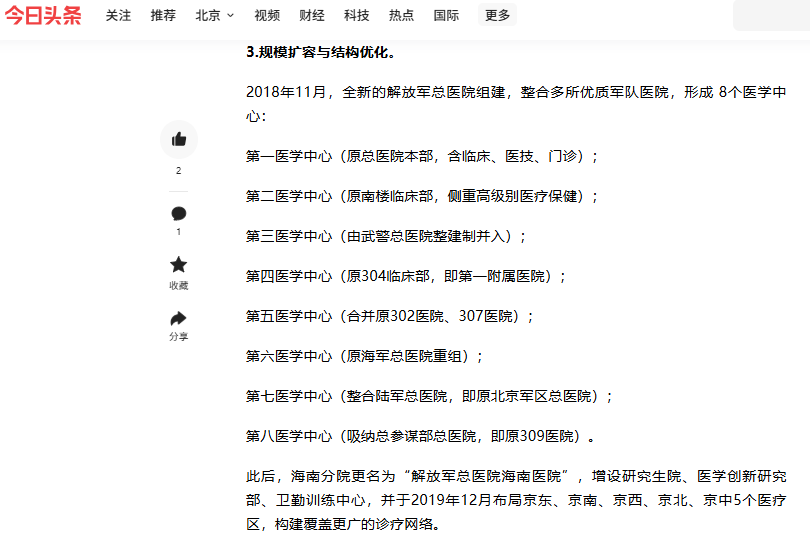
November 2018: A new PLA General Hospital structure was formalized, integrating multiple high-level military hospitals into eight medical centers:
First Medical Center: Original hospital headquarters (clinical, diagnostic, outpatient).
Second Medical Center: Former South Tower Clinical Department, focused on high-level medical care.
Third Medical Center: Fully integrated Armed Police General Hospital.
Fourth Medical Center: Original 304 Clinical Department (First Affiliated Hospital).
Fifth Medical Center: Consolidation of 302 and 307 Hospitals.
Sixth Medical Center: Reorganized Navy General Hospital.
Seventh Medical Center: Integrated Army General Hospital (former Beijing Military Region General Hospital).
Eighth Medical Center: Absorbed General Staff Hospital (former 309 Hospital).
Hainan Branch: Renamed PLA GH Hainan Hospital; added Graduate School, Medical Innovation Research Department, and Health Support Training Center.
December 2019: Five new medical regions were established (East, South, West, North, Central Beijing) to expand coverage and care networks.
Administrative Rank Adjustment
Post-reform, while the hospital’s scope and scale far exceeded its pre-reform status—eight medical centers, one Hainan hospital, five medical regions, integrating clinical care, education, research, and health support training—its administrative rank was reduced from full-rank (正军级) to deputy-rank (副军级).
This change was not a functional downgrade. Rather, it reflects the military reform principle of aligning non-combat unit rank with practical operational needs.
As a unit under the JLSF, the hospital’s core tasks include:
Coordinating treatment of complex military-wide medical cases
Enabling cross-branch medical collaboration
Supporting wartime medical logistics and care
The rank adjustment reduces bureaucratic layers, improves operational efficiency, and enhances the hospital’s ability to interact with the JLSF for rapid deployment of medical resources.
Key Takeaways
The PLA General Hospital is now the largest integrated medical complex within the PLA, combining multiple clinical centers, teaching resources, research departments, and training facilities.
Its evolution illustrates the PLA’s strategy of centralizing medical expertise, integrating academic resources, and aligning medical capability directly with the joint logistics framework.
The hospital serves as a critical bridge between military medicine, research innovation, and logistical support, reflecting China’s broader approach to strategic military medical modernization.