

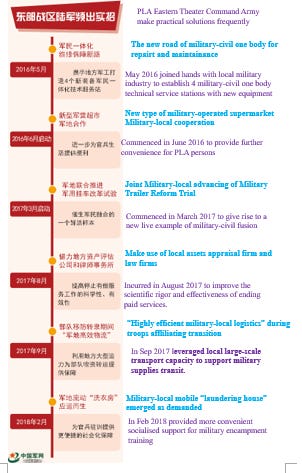
While official rhetoric presents Chinese Communist Party (CCP) Military-Civil Fusion (MCF) as a benign framework for economic optimization, primary state disclosures paint a vastly different picture. Intelligence analysis of state media reports reveals how civilian logistics networks, industrial standardization, and online information portals are systematically weaponized to ensure seamless operational support for military combat forces during war.
Reports published by the CCP Military Daily (PLA Daily) highlight two critical pillars of this strategy: the military standardization of commercial logistics containers and the centralized digital indexing of civilian technologies for military conversion via state-run portals.
Logistics Containerization: Forcing Civilian Commerce into Military Specifications
Writing in state media, Wang Guixin—Secretary-General of the Military-Civil Fusion Special Committee of the China Packaging Federation—explicitly benchmarked China’s military logistics goals against U.S. wartime deployment speeds during recent regional conflicts. To bridge the gap, the CCP is executing a total-society logistics overhaul designed to force civilian supply chains into military-compatible units.
Mandatory Dual-Use Standardization: The initiative mandates that civilian shipping containers, pallets, and returnable crates adhere strictly to military transportation specifications. This alignment ensures that commercial cargo assets can be instantly commandeered and integrated into military transport systems during wartime.
Massive Infrastructure Scale: The strategy envisions a nationwide pool of over 10 billion standardized pallets and returnable containers. This infrastructure ensures that civilian logistics firms—such as e-commerce giants and commercial shipping lines—operate as an immediate, pre-packaged mobilization reserve for military logistics.
Intermodal Combat Deployment: By aligning commercial container standards with military intermodal requirements, the armed forces eliminate loading and unloading bottlenecks at ports, railway hubs, and field supply depots during high-intensity force projection.
Digital Procurement Portals: Indexing Civilian IP for Military Application
Parallel to physical supply chain conversion is the digital co-optation of civilian technology through state platforms like the National Military-Civil Fusion Public Service Platform. Operated under the Ministry of Industry and Information Technology (MIIT) and state defense agencies, this portal serves as a operational bridge between civilian enterprises and military procurement officers.
+-----------------------------------------------------------------------------------+
|            STATE PORTAL STRUCTURE: DUAL-USE TECHNOLOGY INDEXING                   |
+-----------------------------------------------------------------------------------+
| Managing Entities | Ministry of Industry and Information Technology (MIIT),       |
|                   | Ministry of Finance, SASTIND.                                 |
+-------------------+---------------------------------------------------------------+
| Core Functions    | "Civil-to-Military" (民参军) technology sourcing, intellectual  |
|                   | property catalogs, and dual-use equipment databases.          |
+-------------------+---------------------------------------------------------------+
| Strategic Impact  | Converts commercial R&D, cloud computing, and IoT systems     |
|                   | directly into accessible military assets.                     |
+-----------------------------------------------------------------------------------+
Through centralized databases—including the Catalog of Intellectual Property Conversion in National Defense Science and Technology and specialized “Civil-to-Military” (Min Can Jun) portals—the party-state maps private-sector patents, cloud architecture, and Internet of Things (IoT) supply networks directly to military operational requirements.
Strategic Implications for Western Defense and Trade Policy
The integration of commercial supply chains and digital technology portals into military planning creates critical risks for global trade and defense intelligence:
Obfuscation of Supply Chains: By standardizing civilian shipping containers to military specifications, the armed forces can blend military logistics into routine commercial shipping channels, obscuring mobilization signatures prior to conflict.
Co-optation of Commercial Intellectual Property: Western corporations entering joint ventures or operating within China’s tech ecosystem face continuous exposure to state platforms designed to harvest dual-use intellectual property for military modernization.
Total Mobilization Infrastructure: The seamless conversion of civilian logistics assets—ranging from port infrastructure to automated sorting centers—ensures that the entire national economy functions as an extension of the armed forces during a regional crisis in the Indo-Pacific.
A Structural Threat to Global Supply Security
The systematic integration of commercial logistics and digital technology portals demonstrates that Military-Civil Fusion is not a commercial policy, but a deliberate preparation for high-intensity warfare. By weaponizing commercial shipping standards and indexing private innovation for military use, the Chinese Communist Party erases the line between civilian enterprise and military power, creating an integrated machine built for wartime mobilization.